

Badrinath Temple
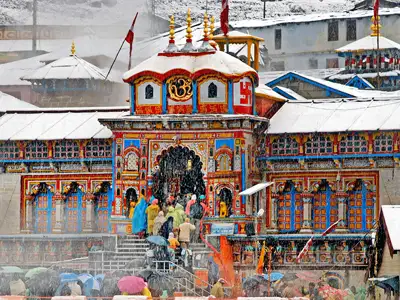
Badrinath Temple or Badrinarayan Temple is a famous Chardham Temple. Badrinath Mandir / Badrinath Temple is situated in Badrinath town and dedicated to Lord Vishnu. With stone walls and carvings, Badrinath Temple has a North Indian style architecture.
Inside Badrinath Temple
The main entrance gate of Badrinath temple is colourful & imposing popularly known as Singhdwar. The temple is approximately 50 feet tall with a small cupola on top, covered with a gold gilt roof.
The Badrinath temple is divided into three parts – the ‘Garbha Griha’ or the sanctum sanctorum, the ‘Darshan Mandap’ where the rituals are conducted and the ‘Sabha Mandap’ where devotees assemble.
At the Badrinath Mandir Gate, directly opposite the main Idol of the Lord himself, is seated the idol of Bird Garud, the vehicle of Lord Badrinarayan, sitting in prayer with his hands folded. The walls and pillars of the mandapa are covered with intricate carvings.
The Garbha Griha portion has its canopy covered with a sheet of gold offered and houses Lord Badari Narayan, Kuber (God of wealth), Narad rishi, Udhava, Nar & Narayan. The complex has 15 idols especially attractive is the one-metre high image of lord Badrinath, finely sculpted in black stone.According to legend Shankara discovered a black stone image of Lord Badrinarayan made of Saligram stone in the Alaknanda River. He originally enshrined it in a cave near the Tapt Kund hot springs. In the sixteenth century, the King of Garhwal moved the murti to the present temple. It represents Lord Vishnu seated in a meditative pose called padmasan.
Darshan Mandap : Lord Badari Narayan is armed with Conch and Chakra in two arms in a lifted posture and two arms rested in Yogic Pose. Badarinarayan is seen under the Badari tree, flanked by Kuber and Garuda, Narad, Narayan and Nar. As you look, standing to the right side of Badrinarayana is Uddhava. To the far right side are Nara and Narayana. Narada Muni is kneeling in front on the right side and is difficult to see. On the left side are Kubera-the god of wealth, and a silver Ganesh. Garuda is kneeling in front, to the left of Badrinarayana.
Sabha Mandap : It is a place in the Badrinath Temple complex where devotees and pilgrims assemble.
Pooja Performed in Badrinath Temple
Special pujas (online too) are performed on behalf of devotees. Every puja must be preceded by a holy dip in the Tapta Kund. Some of the morning pujas are – Mahabhishek, Adhishek, Gitapath and Bhagwat Path, while the evening pujas are Geet Govind and Aarti. Special Badrinath pooja booking can be done at Badrinath Mandir Committee by paying some fees. The procedures of daily pujas and rituals are supposed to have been prescribed by Adi Shankracharya. Unlike most Hindu temples, all the pujas (including the decoration of idols) are performed in the presence of the devotees.
Aarti Timings in Badrinath: The daily rituals at the Badrivishal temple start very early, around 4.30 am with maha abhishek and abhishek puja, and end at around 8.30 -9 pm with the shayan aarti. The temple opens for darshan for the general public around 7-8 am and there is an afternoon recess between 1-4 pm. The Rawal of the temple performs the rituals.
Badrinath Temple Opening and Closing Time
The Badrinath temple opens at 0430 hrs & closes at 1300 hrs. Once again it opens at 1600 hrs & closes at 2100 hrs after the divine song Geet Govind.
Badrinath Temple General Information
- Administrator – Pujari of the temple named as Rawal Ji is well versed in puja ceremonials & Sanskrit language and must belong to a kerala Brahmin family.
- Photography is strictly prohibited inside the temple.
Opening and Closing Ceremonies in Badrinath Temple
Pujas are held during the opening and the closing of the Badrinath temple. The temple is open for six months of the year – from April-May to October-November, but its day of opening is determined on the day of the Basant Panchami (in February-March), in accordance with astrological configurations.
Management of Badrinath Temple
Earlier, under The Uttar Pradesh Act No. 30/1948 the administration of Kedarnath Temple was included in the Badrinath Temple Act no. 16, 1939 and it came to be called Shri Badrinath and Shri Kedarnath Mandir Act. The same Mandir Samiti (committee) governed both the temples. Further amended in 2002 after the formation of the 27th state of union of India, the act provides provisions of increasing the number of members, one vice chairman and adding Government officials to the committee. Now Uttarakahand Char Dham Devasthanam Board formed on 15 January 2020 governed all temples including Kedarnath & Badrinath.
Historical Development of Badrinath Tempke
- Construction by Garhwal Kings : While Adi Shankaracharya is credited with the temple’s establishment, the present structure is believed to have been built by the Garhwal kings in the 16th century. King Ganesh Shah is particularly associated with the reconstruction of the temple.
- Architectural Style : The temple’s architecture is reflective of the traditional Garhwali style, characterized by stone and wood construction. The intricately carved facade, arched windows, and conical-shaped sanctum showcase the architectural finesse of the time.
Cultural Evolution of Badrinath Temple
- Pilgrimage Site : Over the centuries, Badrinath Temple has evolved into a major pilgrimage site in India. Its inclusion in the Char Dham Yatra, a sacred journey covering four major religious sites, has only heightened its significance.
- Cultural Practices : The rituals and practices associated with Badrinath Temple have been passed down through generations. Pilgrims believe in the spiritual significance of taking a dip in the Tapt Kund before entering the temple, and various pujas and aartis are performed regularly.
Badrianth Facts
- Area3 sq kms
- Altitude3133 mts
- DistrictChamoli
- StateUttarakhand
- SeasonApril to November
- Famous forPilgrimage, Temple
- Pincode246422
- STD Code01381

